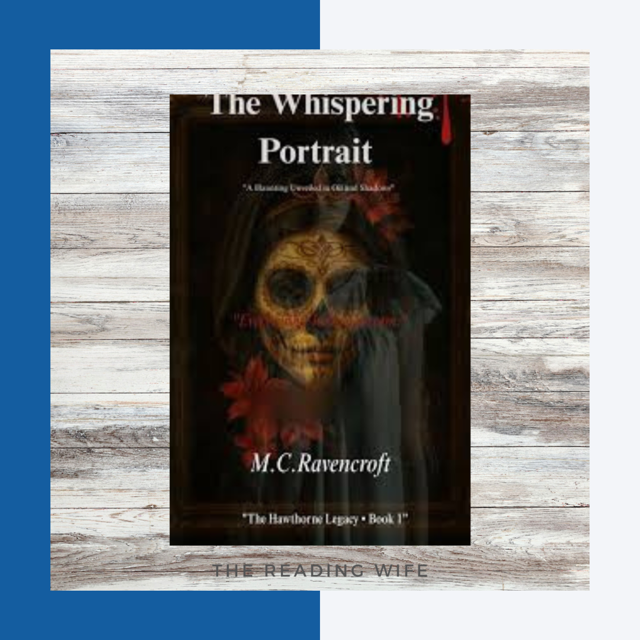
The Whispering Portrait
Table of Contents
The Whispering Portrait
The Whispering Portrait is the latest short story to be checked off my to be read list. If you’ve followed me for any length of time, then you know I love a good short story. It is autumn, and as the weather turns colder, I find myself wanting to curl up with a good story.
But this is the time of year where time speeds up, and I find myself busy. I’m quite sure that I’m going to blink and the holidays will be here tomorrow. Time goes that quickly for some reason once fall hits.
This post contains affiliate links
I do love fall because it means hoodies, football, and soup. This also means that I have a little bit less time for reading. Short stories like this mean that I can still start and finish a story, and watch football as well. It means I’m not sacrificing my reading time, just shifting how I make it happen more often.
At the time of publishing this review, The Whispering Portrait is available via Kindle Unlimited, making it easily accessible to readers. This helps me utilize my subscription instead of just being billed for it and forgetting about it.
It is also an excellent way to discover new and different authors that I may not have tried otherwise. Which I love. Giving new authors a chance because their stories are available on Kindle Unlimited is something of a scavenger hunt for me. Finding that one book or story that hooks you and is simply perfect is always my goal. I want to find something I never would have discovered otherwise.
Have you read The Whispering Portrait? Come on in and let me tell you about it!
About The Whispering Portrait
The Whispering Portrait
When Clara Hawthorne inherits her grandmother’s crumbling estate, she also inherits the last painting Evelyn Hawthorne ever touched, a portrait that should be still… but whispers her name in the dark.
Initially, Clara dismisses it as a trick of her grief. But the voice grows louder. And the woman in the painting—who looks disturbingly like Clara—starts to change.
As Clara digs into her family’s cursed legacy, she uncovers a trail of buried secrets, vanished artists, and a gallery of portraits that should never have been painted. Each one tells a story. Each one hides a soul. And one of them is about to claim hers.
In this gothic horror mystery, where art bleeds memory and silence hides screams, Clara must confront the truth behind her grandmother’s final masterpiece before it consumes her.
Thoughts on The Whispering Portrait
The Whispering Portrait reminded me a bit of Mexican Gothic, in that the author was trying to build the same kind of vibe and atmosphere. I love the concept.
The problem for me is the simple fact that it is a short story. This one really could benefit from being a full novel so that the atmosphere could be built correctly. It simply moved a little too fast for my liking. But, I’m also totally comparing it to Mexican Gothic, because I loved the atmosphere-building in that story.
For me, a great short story should both leave me wanting more, yet feel complete at the same time. This one didn’t feel complete, like it wasn’t built properly from the foundation and beginning.
This was a good story, there was nothing wrong with it. But I really wanted great things, and the potential is absolutely there to make it happen. It is clear that M.C. Ravencroft is a talented writer. But the medium of a short story instead of a full novel is wrong for me.
Final Thoughts on The Whispering Portrait
I’m calling The Whispering Portrait a three star read. Which I have to admit, makes me a bit sad. As I said earlier, this story has serious potential, and would be perfect as a full novel. That way each character and the atmosphere could be built perfectly. That takes time and pages, that a short story just doesn’t allow for.
I find myself often mad when a story has so much potential, but it just doesn’t quite reach that optimal place, yet it is crystal clear to me it could be there. I felt the same way about The Tattooist of Auschwitz, and a novel simply wasn’t the right medium for the story. Or The Stranger in the Woods should have been a magazine article. Half of making something perfect is picking the right medium to deliver it to your audience. Otherwise it can just fall flat.
A three star read for me is still good, but I’ll have forgotten it by the time I publish the review, because it wasn’t memorable. Because it wasn’t memorable, I can’t rate it higher than three stars. Given that there was nothing egregiously wrong with it, I can’t rate it any lower than three stars either. It’s just… okay.
As with any story that I’ve reviewed, I always encourage you to go and read it yourself and form your own opinions. You may end up loving it, and I really hope you do. That is kind of the fun part about reading, it is so subjective. The Whispering Portrait is just waiting for the right reader to find it!
Discussion
Have you read The Whispering Portrait? Are you a fan of short stories? I love autumn for its spooky season. Do you read books or short stories based on the seasons?
Discussion Questions
- Was Edward Harrow ever human? Or was he something else wearing a man’s likeness?
- Why do you think Evelyn Hawthorne never finished her self-portrait?
- Should Clara have painted Edward a new prison instead of destroying him?
- The book suggests art can trap souls. Do you think creativity has a moral cost?
- Who was the real villain, Edward, Evelyn, or the Hawthorne Method itself?
- What did you make of the final line, “See you soon, Clara: and is Edward truly gone?
About the Author
M.C. Ravencroft writes cozy mysteries and romantic comedies set in small towns with big secrets. She is the author of the cozy whodunits The Whispering Portrait and Dark Vanish, as well as rom-coms featuring awkward heroines and the charming small towns that drive them crazy (in the best way).
When not plotting fictional murders or meet-cutes, she can be found in New England, baking scones, searching for a lost cup of tea, and living with her family and a very noisy parrot named Shakespeare.
Author Note
Some stories begin with a question. This one began with a painting.
Years ago, I stood in a dim museum gallery, staring at a 19th-century portrait.. The subject’s eyes seemed to follow me, her smile too knowing for brushstrokes and varnish. Later, I learned the artist had died mysteriously after completing it. That night, I dreamed the woman in the painting blinked.
The Whispering Portraits was born from that unease, the fear that art isn’t always inert, that creativity might leave echoes in the canvas. Evelyn Hawthorne’s cursed paintings owe their DNA to real legends:
The “Haunted Portraits” of Renaissance Europe, said to age or weep. The Dybbuk Box myth, where objects trap spirits.
My own grandmother, a watercolorist who claimed her paints “remembered” the past. But Clara’s story is about more than ghosts. It’s about legacy, what we inherit from our ancestors, and what we choose to destroy.
May your own reflections stay still in the glass.
L.K. Stone
Purchasing The Whispering Portrait
- If you are interested in buying the paperback version of The Whispering Portrait, click here.
- Click here for the Kindle version.
- Click here for my favorite Kindle I currently own.
Amazon Notice
The Reading Wife is a participant in the Amazon Services LLC Associates Program, an affiliate advertising program designed to provide a means for sites to earn advertising fees by advertising and linking to Amazon.com, at no added cost to you.